

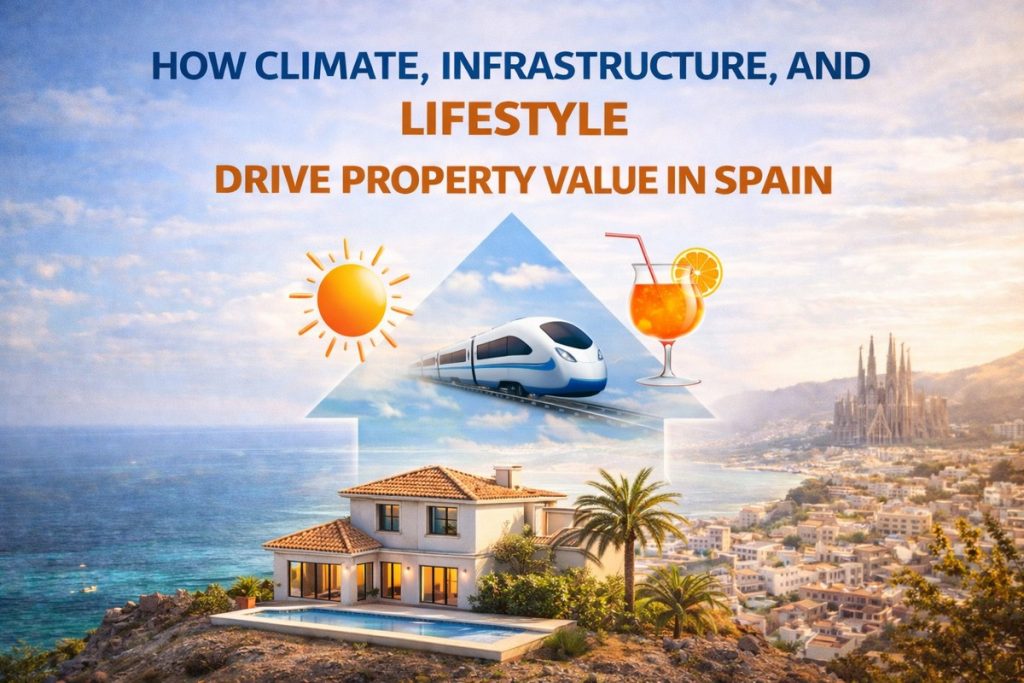
What makes a location in Spain truly desirable (and thus more expensive)? Beyond the usual suspects of supply and demand, there are three big-picture factors that profoundly influence property values across Spain: climate, infrastructure, and lifestyle. These macro drivers often explain why one town’s real estate soars while another’s stagnates. For property owners and investors, understanding these factors can help identify the next hot (or cool) spot and appreciate what gives Spanish locations their value.
Climate: The Sunshine Effect (and a Note on Climate Change)
It’s no coincidence that Spain’s priciest real estate per square meter is found in places with dreamy climates. Think of the Costa del Sol, Costa Blanca, the Balearic Islands, or Canary Islands. The common denominator? Sun, warmth, and mild winters:
- Sunshine Sells: International buyers flock to Spain for its abundant sunshine. The Costa del Sol, for instance, boasts 320+ days of sun a year. That kind of climate is practically a cheat code for attracting retirees, holidaymakers, and remote workers. Property values reflect this premium – coastal towns like Marbella or Javea command far higher prices than cloudier inland towns on the same latitude. People literally pay for good weather. A study of expat preferences showed nearly 99% of expats in Valencia are happy with its climate (Mediterranean mild) – no surprise Valencia tops expat city rankings. The “Sunshine Effect” means that even within Spain, areas with more temperate micro-climates (say, a south-facing hillside that’s shielded from northern winds) can see higher prices than surrounding areas.
- Year-Round Enjoyment: A good climate extends tourism and occupancy beyond just summer. For instance, the Canary Islands (eternal spring climate) have high rental and occupancy rates even in winter, boosting property income potential. This drives up investment value there. In contrast, a beautiful but frigid inland winter town might struggle to attract year-round residents or tourists, keeping values lower. Spain’s southern coasts and islands effectively offer a “12-month season” thanks to climate – a big value booster.
- Climate Change Considerations: Interestingly, climate change is starting to shuffle the deck a bit. Summers are getting hotter – coastal areas that were merely “very warm” are sometimes hitting extreme highs in August. This hasn’t yet hurt property demand; in fact, it’s reinforcing the desire of northerners to have a sunny escape. But some forward-thinkers are eyeing the traditionally cooler northern coast (Galicia, Cantabria) as they remain temperate in summer and very lush. Those areas historically were cheaper due to rain and cooler temps, but as Europe faces more heatwaves, even Spain’s “Green Coast” looks more appealing. We haven’t seen a mass shift yet, but it’s a trend to watch. Overall though, Spain’s varied climate means you can choose your preferred balance of heat vs. mildness – and property values align accordingly. A ski chalet in the Pyrenees or Sierra Nevada has its value driven by winter sports climate, whereas a villa in Málaga sells summer and mild winter living. Microclimate matters too: for example, Jávea (Xàbia) on the Costa Blanca is famed for having one of the world’s healthiest microclimates (per WHO), and its property market reflects that in higher prices and foreign demand.
Infrastructure: Connectivity and Development as Value Catalysts
Infrastructure – from transportation to healthcare – is often behind a region’s rise in property fortunes:
- Airports and Access: When an area becomes easily accessible, real estate values climb. Spain’s investment in airports and budget airlines connecting them has huge impact. Look at Málaga – its international airport (with tons of flights from all over Europe) is a key reason the Costa del Sol boomed. A beach town within an hour of an international airport will generally see more foreign buyer interest (higher prices) than one that’s 3 hours of winding roads from the nearest hub. The new Corvera airport in Murcia, once it matures, is expected to boost nearby Costa Cálida values by shortening the trip for visitors. Islands like Mallorca or Ibiza – prime property markets – justify their high prices partly because they have well-served airports making them weekend-accessible from abroad. In short, connectivity equals demand.
- High-Speed Rail & Highways: Spain’s AVE high-speed rail network has been transformative. Example: the AVE line Madrid-Sevilla, after it opened, property prices in Seville jumped 10–25% in the following years. Why? Suddenly Sevilla was under 2.5 hours from Madrid, making it viable for businesses and commuters – boosting the local economy and housing demand. Likewise, the AVE to Valencia and Málaga made those places more attractive for weekenders and relocators. If tomorrow a high-speed train connects, say, Málaga to Granada, you can bet Granada’s property values would benefit. Good highways similarly open up areas. When a new highway or bypass is built reducing travel time to a city or airport, nearby property often appreciates. Spain’s infrastructure is generally excellent – roads, trains, public transit – and areas with better connectivity and transit options command a premium. Within cities, proximity to metro or bus hubs raises apartment values.
- Urban Development & Facilities: Infrastructure isn’t just transport. It’s also schools, hospitals, shopping centers, broadband internet, etc. A town with a brand-new hospital or international school will see more families moving in (and willing to pay more). For retirees, knowing there’s a good hospital nearby is key – hence areas like the Costa Blanca, which have numerous modern hospitals and clinics (partly due to the expat population), attract even more retirees, a reinforcing cycle. Broadband and telecom infrastructure is another – remote workers prioritize places with fiber-optic internet. Spain has surprisingly great fiber coverage even in smaller towns, which has enabled rural property markets to see some revival (people moving to villages but still working online). When small towns invest in digital infrastructure, they make themselves relevant to new demographics, lifting property appeal.
- Projects and Regeneration: Sometimes a single project can change a locale’s fate. The Bilbao Guggenheim effect (one iconic infrastructure/cultural investment turning an industrial city into a tourist magnet) is a classic example – property values in Bilbao surged after the museum and waterfront renewal. In Málaga, the creation of the Tech Park and the Pompidou/CAC museums has turned it into a cultural/tech hub, boosting its real estate dramatically the past 5 years. When cities invest in upgrading ports, promenades, or adding tram lines, these all filter into higher desirability and prices. Spain has many EU-funded projects continually improving cities and towns – savvy investors track these. If you hear “a new marina is being built” or “AVEs slated for XYZ by 2026”, that’s often a cue that property values will get a nudge up.
In essence, infrastructure is value infrastructure. It’s no wonder that the Costa del Sol promotes its modern infrastructure in marketing – international airport, highways, high-speed rail to Madrid, world-class hospitals… These are cited as key reasons it’s a top investment destination. Areas that lack infrastructure (poor roads, isolated locales) usually have much lower property values – unless the charm of isolation is itself the selling point for a niche.
Lifestyle: The “Liveability” Factors and Culture
Finally, lifestyle – a broad term encompassing quality of life, culture, services, safety – plays a massive role in property desirability in Spain:
- Quality of Life and Expat Appeal: Spain consistently ranks at the top for quality of life. It was named the #1 country for expat quality of life three years running by some surveys. This isn’t just climate and infrastructure, but everyday lifestyle: excellent healthcare system (Spain has one of the world’s best healthcare, which gives confidence to retirees especially), a rich culinary and wine scene, vibrant social life, and a pace of life that outsiders find appealing (the famous siesta and late dinners). Certain areas have developed lifestyle “brands” – e.g., Marbella for luxury resort living with golf and glitz, or Ibiza for chic party and wellness lifestyle, or Barcelona for cosmopolitan culture by the sea. These reputations draw specific buyer groups and keep prices high. A region’s lifestyle reputation can be as important as hard infrastructure. The fact that Málaga, Valencia, Alicante rank top 3 in expat city rankings speaks to how their blend of climate + amenities + social life is valued, and indeed those cities’ property markets are booming with foreign demand.
- Cultural and Historical Charm: Lifestyle also includes the intangibles of charm and beauty. A picturesque historic center, a lively tapas bar scene, local festivals – these make a place desirable to live in or visit. Towns that preserve their cultural heritage often see stronger demand (think Granada with its Alhambra and old town – always high on travelers’ lists and increasingly on remote workers’ lists). On the flip side, a cookie-cutter modern development may lack soul, which could limit its appeal to certain buyers. Many foreign buyers specifically seek that Spanish lifestyle – whether it’s pueblo village life or trendy urban life – and properties that embody it (like a rustic finca, or a modernist city flat) are valued not just as assets but as experiences.
- Safety and Security: Spain is generally very safe (low violent crime, etc.), and this is a huge lifestyle plus that boosts property values (people feel comfortable investing in second homes or moving families here). Areas known to be especially safe or family-friendly often see more demand from those demographics. Gated communities or developments with security also fetch premiums as they offer peace of mind (particularly to some international buyers).
- Leisure and Recreation: Proximity to leisure activities drives value. Golf courses are a big one in certain markets – “Golf front” properties in the Costa del Sol or Costa Blanca have a niche but strong market (some buyers will pay extra to live in a golf resort community for that lifestyle). Similarly, being near marinas (for boating lifestyle) or having easy access to hiking and nature (like near the Montseny park outside Barcelona, or Sierra Nevada for skiing) can make a difference. Spain’s diverse geography means you have beach, mountains, countryside – each with its lifestyle. Areas that offer a unique combo (e.g., Malaga you can ski and hit the beach in the same day in winter) use that to attract people.
- Community and International Services: For foreign residents, lifestyle can be impacted by whether there are international schools, English-speaking services, etc. For instance, the presence of reputable international schools in an area like the Costa del Sol (there are several) makes it viable for expat families, thus increasing demand for family homes there. The more an area caters to an international lifestyle (multi-lingual doctors, social clubs, etc.), the more global demand it can sustain. That said, some buyers want an authentic Spanish community vibe – which can also add value in a different way (think a charming village that limits overdevelopment; its authenticity itself becomes the selling point).
In summary, lifestyle is king. People often choose Spain not just for a house, but for a way of life. Locations that deliver that idealized lifestyle – whether it’s relaxed coastal living, vibrant city culture, or peaceful village simplicity – see their property values bolstered by emotional demand, not just investment logic.
The Synergy of All Three
The magic happens when climate, infrastructure, and lifestyle all align in one place – those are your superstar property markets. For example, take the Costa del Sol:
- Climate? Check – sunshine and mild winters.
- Infrastructure? Check – top-notch (international airport, highways, AVE to Madrid, hospitals).
- Lifestyle? Check – international vibe, golf, beaches, restaurants, safety, cultural events, etc.
No wonder the Costa del Sol is a “preferred destination for real estate investment” and continues to see record-high property prices. Similar stories in Balearic Islands or city regions like Madrid (not coastal, but good climate part of year, incredible infrastructure as a capital, and cosmopolitan lifestyle). On the flip side, if a location lacks one of these, it may lag. Perhaps a beautiful climatically blessed area but with poor infrastructure (some parts of Extremadura come to mind) remains inexpensive. Or a place with good infrastructure but less exciting lifestyle might not ever become “hot”. For investors, spotting up-and-coming areas often involves looking for improvements in one of these three that could elevate the location. Is a new train line coming (infrastructure) to a charming town? Is a region being “discovered” by remote workers for its great climate? These can be catalysts for property appreciation. At Costa Dream Home, we don’t just sell properties – we sell the Spain lifestyle dream, backed by the reality of climate and infrastructure. We advise our clients to consider these fundamental value drivers. It’s not just the house, it’s where the house is. As you plan your property purchase, think about these elements. Do you crave endless sunshine or a cooler summer? Do you need seamless connectivity for work or travel? What kind of life do you envision in Spain? By matching these preferences with the right location, you not only ensure a happier life, but likely a sound investment too. Let us guide you to those special spots in Spain where climate, infrastructure, and lifestyle come together. We have deep local insight into which areas are on the rise and why. With our help, you can make an informed choice – securing not just a property, but the quality of life (and future value) that comes with it. After all, in Spain, a house is more than bricks; it’s bienestar – well-being – under the Iberian sun.